An Excellent Motorcycle Adventure! Day 6!
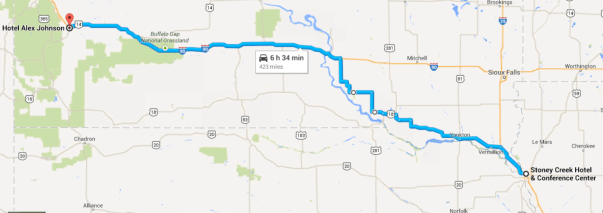
A giant low pressure weather system in Canada system has caused us to detour west and south.
An Excellent Motorcycle Adventure! Day 6!
Dealing with Weather…
Given Day 5 problems with the weather, we are extra vigilant at the start of day 6. We set the alarm[1] for 5:00 AM and immediately log into our ASTT devices and turn on the Weather Channel. The meteorologists explain not only what happened to us yesterday but what is likely to happen to us today.
There is a HUGE low pressure weather system in northern North Dakota and southern Canada, centered over Winnipeg, Manitoba. It has stalled on its eastward progress, slowly drifting along the Canadian border at only a few miles an hour. It is a powerful storm system that is dominating the weather in the center part of the country. The counterclockwise flow of the system is drawing huge amounts of moisture up from the Gulf of Mexico and triggering thunderstorms in a line stretching from Louisiana, through Sioux City (our current location) and up through Pierre SD, Bismarck ND and into Canada (which is our planned travel route for the next two days). We have planned 736 miles of travel over the next two days, finishing in Williston ND[2], but given that Day 6 and Day 7 weather forecasts look like a repeat of Day 5 we are concerned about our ability to cover this distance. We made only 30 mph yesterday[3], so the planned 736 miles of travel could easily take three or even four days if the weather stays bad…. and there is every indication that it will stay bad.
So it is time to make a decision. Do we preserve our route and spend a couple of more days on the road on our westward journey? Or do we alter the route and take a more southerly route… giving up on Northern Montana… but that gets us to some schedule obligations that we have in California the second week of July?
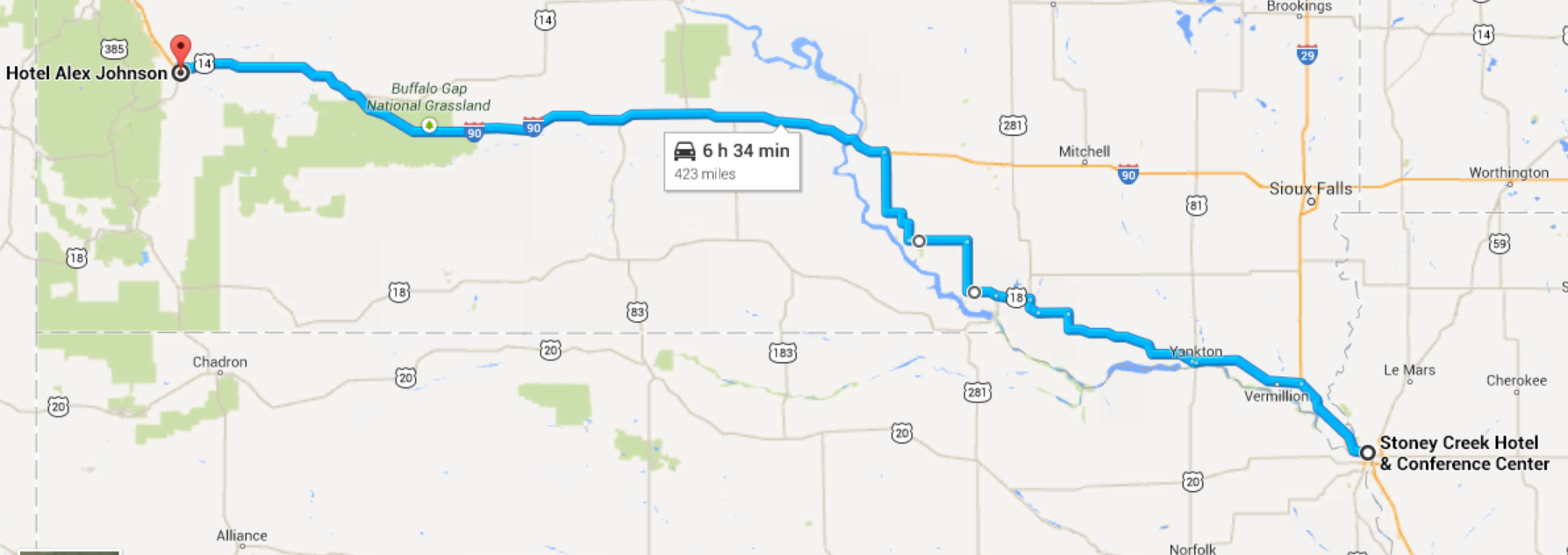
We discuss all the ins and outs of this decision and finally we decide that fighting rainstorms for the next two or three days is not anyone’s idea of fun. We reroute our trip to head today for Rapid City South Dakota. In particular, we are going to try to head west as soon as we can today to avoid the immediate threat of rain in Sioux Falls SD, our planned route. Our route today will be predominately westerly. It is likely we will dodging isolated rain showers the whole day, but we should be able to make decent time. Our endpoint in Rapid City puts us just about as far west as Williston ND… so we are effectively saving a day in our trip west[4].
All this is accomplished before 6:30 AM. We pack and head down to the “free” breakfast buffet offered by the hotel[5]. We are on the road before 8:00 AM.
Dodging Rain Storms in South Dakota… Sioux City IA to Chamberlain SD
The route we have chosen this morning generally heads in a westerly direction, but gradually drifts north over the course of the morning. We are taking route SD-50, a country road, passing through Yankton SD and then through a series of small villages and towns before eventually joining the interstate highway, I-90, just east of Chamberlain SD. This leg of the journey is about 217 miles and it should take us, with stops, a little more than four hours.
As we begin, the weather is still very much a threat.
We depart north on I-29 for about the first seven or eight miles, before taking the exit for SD-50 in Vermillion SD, home to the University of South Dakota.[6] SD-50 generally follows the route of the Missouri River, and is part of the Lewis and Clark Trail… but the river is generally out of sight about one to two miles south of the road. The geography is considered to be “river bluffs”, but they are nowhere near as severe as the high limestone bluffs that we saw in Missouri. The road rises and falls gently on gentle hills passing through farmland, approaching Yankton from the east.
To the left (south) the sky is brightening and the threat of rain seems less. To the right (north) the sky is threatening and overcast and the threat of rain seems very real indeed.
We stop for gas in Yankton SD. Yankton is the biggest town we will pass through this morning, with a population of 14,454. Lewis and Clark were here in August of 1804, where they met with the Yankton Sioux. It was the original capital of the Dakota Territories prior to statehood.[7] The present city consists of two main roads meeting at an intersection in the center of town… Fourth St and Broadway. The Missouri River is just a few hundred feet south of the center of town, Broadway St crosses the Missouri on the new Discovery Bridge, named for the Lewis and Clark Discovery Corp.
At the intersection of 4th and Broadway, SD-50 turns north, after an almost due westerly course from Vermillion. The route respects the grid formed by the surveyed, one-square-mile sections that are the hallmark of the 19th century settlers’ attempts to impose order on the wild countryside they were trying to tame. This will become the pattern for the next several hours: travel north for a few miles, then turn left and travel west for a dozen or more miles, then turn right and travel north again for a short stretch, then west again. Over and over. In the beginning, we are more westerly than northerly, by the time we reach Champion SD, SD-50 will be a more northerly route than westerly.
As we are leaving Yankton, we encounter intermittent raindrops and can clearly see rain showers ahead of us. We have a short conversation about whether we should put on our spiffy rain suits.[8] Before we can come to a decision, we take a left turn west and the threat of rain subsides.
Route SD-50 is our first successful run on a country road. Our previous attempts in Missouri were disappointing, the rods were too twisty and turny, but this road is excellent. Each segment is generally straight, with gentle up and down hills. The topography is generally flat, so we can see easily for five or ten miles. When we crest a small hill, we can see for twenty miles. It is all farmland here, mostly corn, but some cattle ranches.
The weather is improving the farther we head west. The brightening skies from the south have continued to improve and we can see blue sky to the south and sometimes the sun is actually peeking through. To the northwest, we can continue to see dark skies and isolated showers. We can see several rainstorms ten to twenty miles away to the north. This is wide open country, at least to my New England eyes; in New England, you would have to be on top of a significant hill or mountain to be able to see as far.
Our strategy of heading west to get underneath the storm seems to be working. The sun is out more often than not… and what had started as a solid overcast sky has turned into a series of puffy cumulous clouds. Every ten miles or so, we pass through a small town. Tabor. Tyndall. Avon. Each with a population ranging from a few hundred to a thousand or so. Wagner. Lake Andes, with its large reservoir and lodges for sport fishing. Geddes. Most of these towns seem to consist of a gas station/convenience store a few houses, and a municipal building or two. The countryside is pretty, this is a great motorcycle road.
We stop in Platte to stretch our legs and have a coffee. The sky has cleared and is mostly sunny[9], although there are still isolated rain storms to the north. Platte has population of 1230, a little bit bigger than most of the towns we have seen this morning. They have a public library. We stop at Casey’s General Store (and gas station).
As we are getting off the bike and taking off our helmets, a young man drives up on a Vesper and admires tour motorcycle, “Nice, bike!” he says, “You can’t go wrong with black!” We thank him for the compliment. The folks inside the store seem friendlier than we have met so far in Missouri or Iowa. This will turn out to be the case for the entire time we are in South Dakota.
A few miles west of Platte, we get within a half a mile of the Missouri River and we turn north again. We have to pause on a northbound leg of SD-50 to let a small rainstorm pass by. It is about a half a mile in front of us and about a mile wide. It is sunny all around us, with just this isolated shower, which passes in about ten minutes. A few miles farther up the road we come to I-90. We are 2000 miles west of our starting point on the Massachusetts section of I-90, six days ago. Six days on a motorcycle and 2000 miles is starting to be a pretty respectable journey. Literature and experience teach us that all journeys have the potential to be transformational, travelers have always experienced insights and epiphanies on long journeys.[10]
Our First Glimpse of The Sublime…
In every landscape the point of astonishment is the meeting of the sky and the earth.
Ralph Waldo Emerson, On Nature
After a few miles on I-90, we come up over a rise and a sign warns us of a steep downgrade for the next couple of miles. We crest the hill and are greeted with a view of the Missouri River, a mile away and maybe 300 feet below us in elevation. The river bluffs on both sides are covered with green grass, they are completely treeless. The contrast of the vibrant green with the blue skies and white clouds is striking and will remain with me a long time.[11] The river is almost a mile wide here[12], tinted to an almost aquamarine color by minerals dissolved in the water a thousand miles upstream. We descend the hill and cross the river. We climb the hill and when we crest it, it is clear that we have left the east for good and have really entered a western landscape. It is achingly beautiful. The treeless hills, undulating in all directions… endless, eternal, under a beautiful sunny sky.
There is a word to describe the source of the kind of emotions we experience, the feelings we experience, in response to beautiful scenery: the sublime. Ralph Waldo Emerson, essentially the founder of the transcendentalist movement, understood it well.[13] Emerson tells us that the delight that we feel in the presence of the sublime is a result of a harmony between man and nature. There is sanctity in the landscape and it can be a source of grace for us.
On his trip, Robert Pirsig[14] crossed the Missouri 180 miles north of here in Mobridge. His description of his crossing is completely applicable to us:
“[We] cruise down [the] heavily trafficked [road] and then there it is at the bottom of the hill, the Missouri. All that moving water is strange, banked by grass that hardly gets any water at all…. We coast down the hill, clunk onto the bridge and across we go, watching the river through the girders moving by rhythmically, and then we are on the other side.
We climb a long, long hill into another kind of country.
The fences are really all gone now. No brush, no trees. The sweep of the hills is so great John’s motorcycle looks like an ant up ahead moving through the green slopes. Above the slopes the outcroppings of rocks stand out at the tops of the bluffs.”
The good feelings we have from this morning continue and carry-over onto this next leg of the journey, 209 miles in distance to Rapid City SD, about another four hours for us in time, including stops.
More Rain, and the Sunshine… On the road to Rapid City SD
About fifty miles west of Chamberlain, we stop at a rest area near the town of Presho. In keeping with the general friendliness of South Dakota, they have terrific rest areas… the best we have seen since New York State. The skies are threatening a little more, with showers off to the north side of I-90. We have picked up a pretty strong cross wind, which makes riding the motorcycle a little more challenging. We pick up a couple of maps of South Dakota, and Rapid City in particular. The rest area staff is amazingly hospitable and helpful.
A gentleman sees our helmets and stops to ask us about our trip. He’s impressed that we have come all the way from Massachusetts, he is a motorcyclist himself… and like most motorcyclists has dreamed of making a big cross country trip. “How are you liking those crosswinds?” he asks and I concede that they are challenging. The winds are about fifteen to twenty miles per hour with 25 mph gusts. When we catch a gust the bike leans into the wind, seemingly on its own… although in reality it is my own body responding to the changing environment. It is a collaborative effort between wind, machine, and rider. He tells us about a great motorcycle road near Rapid City: route US-16 south from Rapid City and into Wyoming. We promise to look into it as we say our goodbyes.
A few miles past Presho, we start to pick up some raindrops, significant enough for us to stop and put on our spiffy rain suits. The road is wet and the rains suits protect us from the mist thrown up by the tractor trailer trucks. We pick up a few raindrops here and there, but mostly we can watch the storms off to the north. The sun comes out in between the stretches of clouds. The land remains starkly beautiful, inspiring.
I am sensitive to the wind… it has become an integral part of the ride… and it has been shifting. This makes sense as we are far enough west now that we are due south of the large low pressure weather system in the north. Its counterclockwise rotation is now starting to produce winds from the west as opposed to the southerly winds we were experiencing this morning. This is tending to send the storm cells toward us as opposed to blowing them across are path.
The landscape is just as beautiful with the backdrop of storm clouds and lightning as it was with blue sky and cumulus clouds.
The bike needs gas, so we stop in Kadoka. There are thunderstorms all around us and rain is starting to fall. Across the street, a half dozen bikes are taking shelter under an abandoned gas station canopy. We decide take shelter have a snack at the Subway restaurant next door where we split a meatball sandwich and a salad. We meet some folks there, who also want to know about our trip, it turns out that they also ride… it seems that there are a lot of motorcyclists in South Dakota.
Finally the rainstorms go by and we can travel the last 100 miles to Rapid City without further incident. The storm clouds are still to the south and the north, but the sun is breaking through sending vast shaft of light across the countryside, creating more beauty.
Emerson has talked about this too, the collaboration of landscape, light, and observer:
“The ancient Greeks called the world κοσμος, beauty. Such is the constitution of all things, or such the plastic power of the human eye, that the primary forms, as the sky, the mountain, the tree, the animal, give us a delight in and for themselves[15]… The eye is the best of artists… [and] as the eye is the best composer, so light is the first of painters. There is no object so foul that intense light will not make beautiful. And the stimulus it affords to the sense, and a sort of infinitude which it hath, like space and time, make all matter gay.”
It has been a great day, the best so far.
Theology or Geology? …a visit to an alternate world…
Ruth has picked out a terrific hotel for us in Rapid City, the Hotel Alex Johnson. It is one of the oldest hotels in town, but has been updated into a kind of boutique hotel. Rapid City seems like a nice town, with a western-hippie-counterculture kind of feel. There is live music on the plaza and a lot of families out and about. The weather is sunny, the clouds are moving along. Everyone seems to be smiling.
We find a terrific steakhouse and get a table. The friendly server[16] wants to know where we are from, and we tell her about that and about the motorcycle trip. Her name is Dawn. We ask her where she is from and she tells us from Fayetteville AR. I ask her how it comes about that she is in Rapid City. She volunteers that she was a theology major at the University of Arkansas, and that therefore the Black Hills are the place to be. She has previously worked for the US Forest Service.
She takes our order and we enjoy our wine. I mention to Ruth that Dawn seems like a fine young person, full of energy and with her life ahead of her. I wonder out loud about whether in addition to her theology degree, if she was ordained as a minister in any church. Ruth is confused. She tells me point blank: “She said she was a Geology major, not a Theology major.” I am chagrinned.
After we have eaten, and declined dessert, Dawn brings us the check. She asks us where we are heading next and we allow as, since we are here, we thought we would go take a look at Mount Rushmore in the morning before heading west to Wyoming. She lights up and tells us not the miss the Needles Highway, a scenic road that winds through the Black Hills Nation forest. She tells us that the rock formations are beautiful.
I decide to resolve this geology/theology uncertainty, so I ask a simple question: “So as a geologist, you recommend them?” She lights up with enthusiasm: “Yes! The rocks are pre-Cambrian granite, more than two billion years old.” We thank her, pay our check, and depart.
Later, over a nightcap back at the hotel bar, I think about this conversation. I’m a physicist, so sometimes I wonder how things can go differently. Quantum mechanics teaches us that the answers that we get depend on the questions we ask. There is an uncertainty principle at work. If we ask about a particle’s position, we can find that out… but we can’t find out about its momentum. If we measure its momentum, we lose the ability to measure its position.
I’m hung up on this geology/theology uncertainty.
Theology or Geology? …a visit to an alternate world…
Ruth has picked out a terrific hotel for us in Rapid City, the Hotel Alex Johnson. It is one of the oldest hotels in town, but has been updated into a kind of boutique hotel. Rapid City seems like a nice town, with a western-hippie-counterculture kind of feel. There is live music on the plaza and a lot of families out and about. The weather is sunny, the clouds are moving along. Everyone seems to be smiling.
We find a terrific steakhouse and get a table. The friendly server[17] wants to know where we are from, and we tell her about that and about the motorcycle trip. Her name is Dawn. We ask her where she is from and she tells us from Fayetteville AR. I ask her how it comes about that she is in Rapid City. She volunteers that she was a theology major at the University of Arkansas, and that therefore the Black Hills are the place to be. She has previously worked for the US Forest Service.
She takes our order and we enjoy our wine. I mention to Ruth that Dawn seems like a fine young person, full of energy and with her life ahead of her. I wonder out loud about whether in addition to her theology degree, if she was ordained as a minister in any church. Ruth is confused. She tells me point blank: “She said she was a Geology major, not a Theology major.” I am chagrinned.
After we have eaten, and declined dessert, Dawn brings us the check. She asks us where we are heading next and we allow as, since we are here, we thought we would go take a look at Mount Rushmore in the morning before heading west to Wyoming. She lights up and tells us not the miss the Needles Highway, a scenic road that winds through the Black Hills Nation forest. She tells us that the rock formations are beautiful.
I decide to resolve this geology/theology uncertainty, so I ask a simple question: “So as a theologist, you recommend them?” She lights up with enthusiasm: “Yes! The rocks are pre-Cambrian granite, the foundations of the world. We can see the proof of God’s creation right before our eyes. They are the sublime.” We thank her, pay our check, and depart.
Later, over a nightcap back at the hotel bar, I think about this conversation. I’m a physicist, so sometimes I wonder how things can go differently. Quantum mechanics teaches us that the answers that we get depend on the questions we ask. There is an uncertainty principle at work. If we ask about a particle’s position, we can find that out… but we can’t find out about its momentum. If we measure its momentum, we lose the ability to measure its position.
I’m hung up on this theology/geology uncertainty.
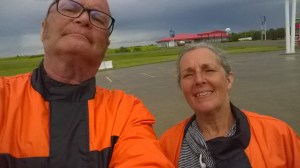
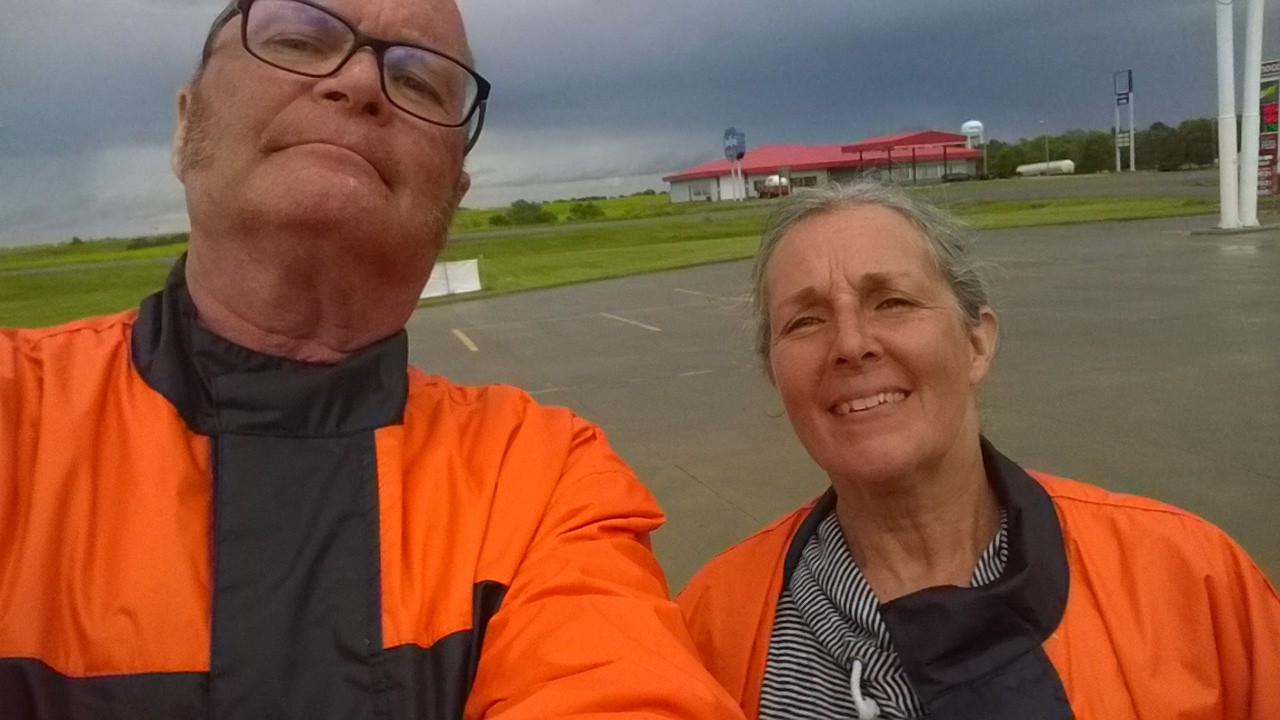
Dodging thunderstorms in our fashionable rain suits in Kadoka SD
Summary
Date: June 28, 2014
Departure Location: 300 3rd St. Sioux City IA
Arrival Location: 523 6th St. Rapid City, SD
Total Miles: 433
Total travel time: 10:07
Total miles/total travel time: 43 mph
Number of States: 2 (Iowa, South Dakota)
Number of Watersheds: 1 (Mississippi River… Missouri River Division)
Stops: 2 (Yankton SD (gas), Platte SD (leg stretch, coffee), Presho SD (leg stretch). Kadoka SD (gas, rain delay, snack))
Weather: Partly Cloudy AM, Thunderstorms PM
Temperature: 7:00 AM (Sioux City) 75 ͦ F, 12:00 Noon (Platte SD) 78 ͦ F, 7:00 PM (Rapid City SD) 73 ͦ F
Lodging: Alex Johnson Hotel, Rapid City SD
Restaurants: Subway, Kadoka SD; Delmonico Grill, Rapid City SD
[1] We are using Ruth’s primitive cell phone as the alarm clock, since my travel alarm clock was a victim off my less than robust luggage packing process.
[2] This is the farthest north that the Lewis and Clark Expedition reached. Lewis had been hoping the Missouri River would continue farther north into what is now Manitoba. Every mile they went further north had the effect of taking land away from the British
[3] Total miles divided by total travel time.
[4] Or, more likely, creating some slack in the schedule in case we encounter additional weather delays.
[5] The “free” breakfast buffet seems to be a standard feature of IHLCs. Sometimes they have a hot buffet, sometimes only cold. They are all unmemorable, but will become a part of our lives for the next week.
[6] Go Coyotes!
[7] The capital was moved to Bismarck in 1883.
[8] It is a typical motorcycle conversation:
“Do you think we should put our rain suits on?”
“WHAT?”
“DO YOU THINK WE SHOULD PUT OUR RAIN SUITS ON?!!”
“I CAN’T HEAR YOU!!!”
[9] I’ve always been pathologically fascinated with the etymology of weather terms. Is mostly sunny the same as “partly cloudy”? What is the spectrum of weather? Here is a possible example: Cloudy; Partly Cloudy; Partly Sunny; Sunny. Where does “mostly sunny” fit in? What goes in between “Partly Cloudy” and “Partly Sunny”. These are the kinds of stupid things you can think about when you have plenty of time driving around on a motorcycle (see Day 3 for other examples). In today’s case, though, there is at least a semblance of some kind of philosophy of language if not outright metaphysics.
[10] The oldest form of fiction is the picaresque novel, which is just folks traveling around having adventures and learning from their journeys… although we readers generally learn more than the protagonists… and we readers tend to learn something about ourselves as well. Canterbury Tales, Don Quixote, Moll Flanders…the great American classic, Huckleberry Finn… and of course, for us Lowellians… On the Road. I think often of the late Charlie Jarvis, my teacher at the University of Lowell, who helped me to connect the dots between these books. He was a personal friend and biographer of Kerouac and an extraordinary thinker. I am richer for the time I got to spend with him.
[11] I think of the dictionary definition of vista which means not just a beautiful view of land or water, but a vision of the future of possibilities; suddenly the two meanings tie together, seamlessly.
[12] The river here is deadwater behind the Fort Randall Dam at Wagner SD, thirty miles downstream. The river here is a long narrow lake, Lake Francis Case.
[13] Emerson wrote, in On Nature, of the great beauty of New England forests and landscapes, where he felt he could experience the presence of God more directly than he could in any church, “Here is sanctity that shames our religions.”
[14] Robert M. Pirsig, Zen and the Art of Motorcycle Maintenance. William Morrow and Company © 1974
[15] Emphasis added.
[16] She is friendly like everyone else we have met in South Dakota.
[17] She is friendly like everyone else we have met in South Dakota.





 wtimothycarey