
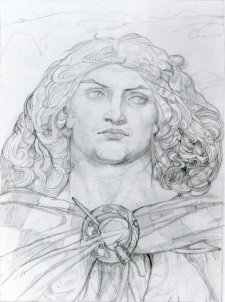
Cú Chulainn by Scottish artist John Duncan (1866 – 1945)
I confess to not being as conversant with Irish poets and mythology as well as I should be. It is a staggeringly embarrassing hole in my literary being. I am ashamed. I ask forgiveness. I will do better.
The two books that I am most familiar with, that actually sit here in my study, next to my desk in the “poetry section” of my library (about 250 books, more or less) are: The Cuchulain of Muirtheme tranlsated by Lady Augusta Gregory in 1902 (with a forward by W.B.Yeats); and The Tain Bo Cuailnge by translated by Thomas Kinsella.
Cú Chulainn is the son of the god Lugh, the equivalent of the Roman god Mercury. His mother is Dechtire, wife of Sualtim. Lugh appeared to Dechtire in the form of a mayfly, and well… you know how things go when gods appear to young women in non-human form.
Fortunately, the portents and prophecies were so strong that Sualtim agreed to raise the resulting son as his own, with help from all: Conchubar contributes a good name, Sencha teaches him words, Fergus bounces him on his knees, Amergin is his tutor.
The judge Morann prophesies: “This child will be praised by all, by chariot drivers and fighters, by kings and wise men; he shall be loved by many men; he will avenge all your wrongs; he will defend your fords, he will fight all your battles”. I have looked and looked and looked and looked for the orginal Irish language version of this quote to no avail.
Cú Chulainn becomes an Irish hero of mythic proportions… a mighty warrior in pre-Christian Ireland, roughly equivalent to Achilles in The Iliad. His name means “The Hound of Ulster“. How he got his name was this way: as a youth, he killed a ferocious watchdog and then offered to take the dog’s place until a replacement could be found. You gotta love a kid like that, possessing a truly inherent nobility.
Although we all love Lady Gregory, sadly, The Cuhulain of Muirteme, is not presented as a poem in Lady Gregory’s translation. The impenetable Irish poetry language has been rendered into prose, similarly to Seamus Heaney’s translation of Beowulf but without the falsity of arranging the prose into artificial stanzas. (Don’t get me wrong: I love Heaney’s Beowulf).
To give an example, if you change Heaney’s translation:
So Grendel waged his lonely war,
inflicting constant cruelties on the people,
atrocious hurt. He took over Heorot,
haunted the glittering hall after dark,
but the throne itself, the treasure seat,
he was kept from approaching;
he was the Lord’s outcast.
to:
So Grendel waged his lonely war, inflicting constant cruelties and atrocious hurt on the people. He took over Heorot, haunting the glittering hall after dark, but was kept from approaching the throne itself, the treasure seat. He was the Lord’s outcast.
you get an idea of Lady Gregory’s translation style.
Of course, the entire The Cuchulain of Muirtheme is now in the public domain. You can find it here: http://www.sacred-texts.com/neu/celt/index.htm#ireland. Or here: https://archive.org/details/ofmuirtcuchulain00gregrich.
The Tain Bo Cuailnge dates from the ninth century CE, but is ascribed to an oral tradition of the first century. It was also rendered into prose. It tells the story of Cú Chulainn’s epic battle and cattle raid against the evil Queen Medb. It is also in the public domain, again the sacred-texts website has it. The Kinsella version ((c) 1969 Thomas Kinsella, Oxford University Press ISBN 0-851085-178-2) is based on an eleventh century manuscript.
That’s it, that’s all I know. I’m sorry it is not more.
A warning for you, my friends: the sacred-texts.com website is a dangerous place; you can easily lose whole days there.


 wtimothycarey